Roman Empire
The Roman Empire occupies a unique and foundational position in Dante's Divine Comedy, serving not merely as a historical polity but as the providentially chosen vessel through which divine justice operates in the world. From the earliest cantos of the Inferno to the culminating visions of the Paradiso, the Empire is presented as the legitimate temporal authority, its history woven into the very fabric of salvation history. Dante's treatment of the Empire is at once a political polemic against the encroachments of the Papacy and a theological argument that the Roman people were elected by God to establish the universal peace necessary for Christ's incarnation and the spread of the Gospel.
Origins and Divine Election
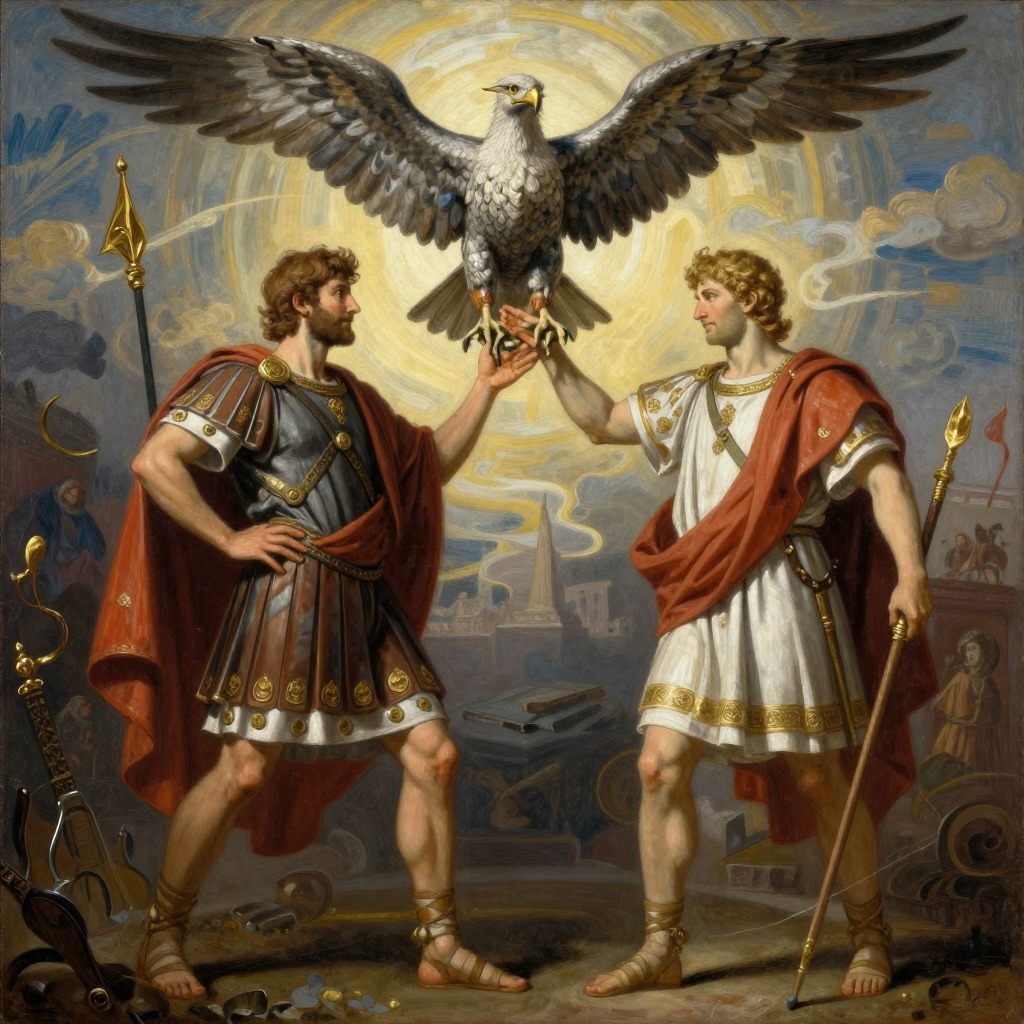
The Empire's sacred origin is traced back to Aeneas, the Trojan hero whom Virgil celebrates. In Inferno II, Dante, hesitating to undertake his journey, recalls that Aeneas, "of Silvius the parent," was chosen to descend to the immortal world while still mortal, because he was "of great Rome, and of her empire / In the empyreal heaven as father chosen" (E00365-E00366). This election was not for Aeneas's own glory but so that Rome might become "the holy place, wherein / Sits the successor of the greatest Peter" (E00367-E00369). The Empire is thus established as the necessary precondition for the Papacy itself: the Roman peace made possible the universal mission of the Church. This providential view is reinforced in the Paradiso when the Emperor Justinian, speaking from the sphere of Mercury, recounts the Empire's history as a continuous unfolding of divine will. He declares that the Eagle—the imperial standard—was worthy of reverence "beginning from the hour / When Pallas died to give it sovereignty" , and that it achieved its greatest glory when, under Augustus, God willed "to bring the whole world to its mood serene" (E10521-E10522), a peace that coincided with the birth of Christ.
The Eagle's Mission and the Condemnation of Factionalism
Justinian's long monologue in Paradiso VI is the poem's most sustained meditation on the Empire's meaning. He himself, after being corrected by Pope Agapetus on the nature of Christ, set the laws in order and then entrusted military affairs to his general Belisarius, so that "heaven's right hand was so joined / It was a signal that I should repose" (E10491-E10493). The Eagle's subsequent history—from the Sabine war through the defeat of Hannibal, the conquests of Caesar, the vengeance of Titus on Jerusalem, and the rescue of the Church by Charlemagne—is presented as a single, continuous narrative of justice. Those who oppose the standard are condemned: the Guelphs who claim it for a party and the Ghibellines who appropriate it for themselves are both guilty, for "'tis hard to see which sins the most" . Justinian warns the new Charles (Charles of Valois) not to strike down the Eagle, for the sons have often wept for the father's crime, and God will not "change His scutcheon for the lilies" . The Empire is not a prize for factional struggle but a sacred trust.
The Two Suns: The Ideal of Separation
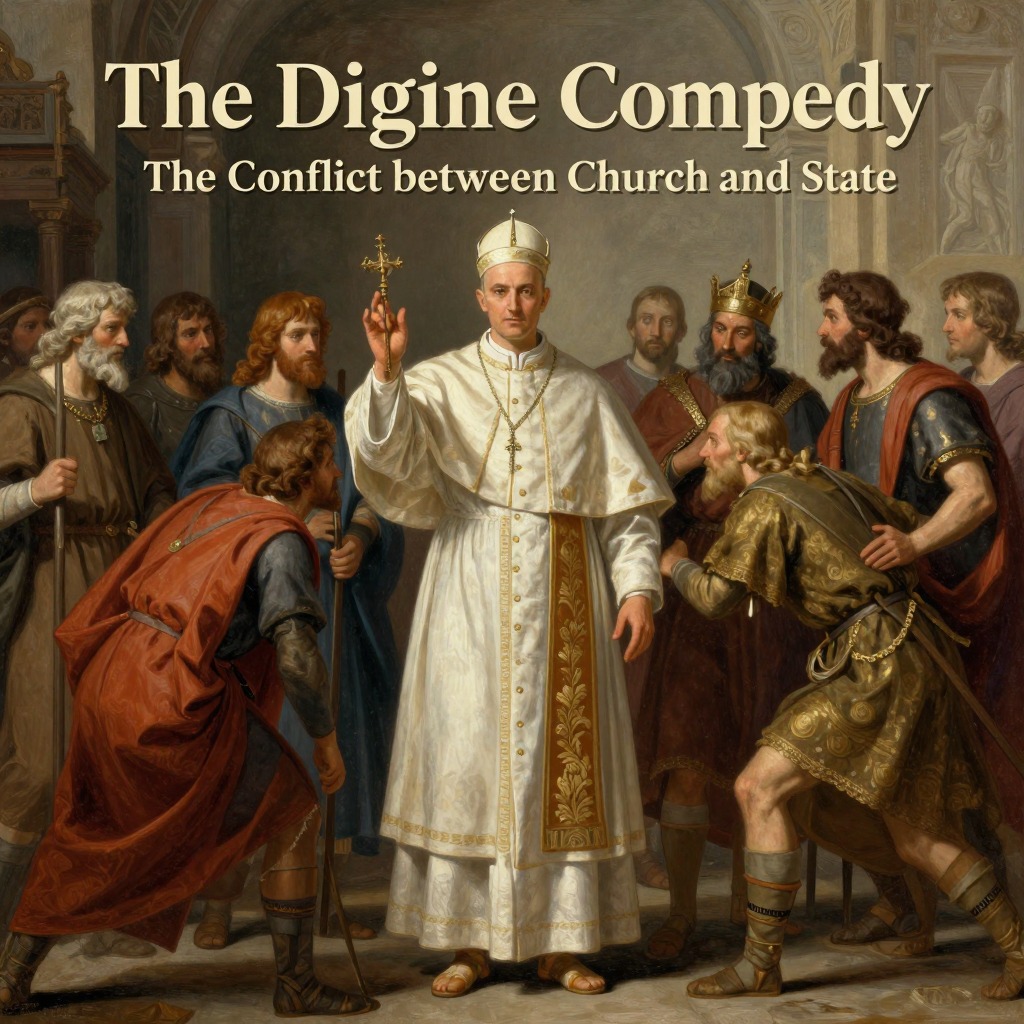
Dante's political ideal, articulated most forcefully in Purgatorio XVI by Marco Lombardo, is the separation of spiritual and temporal authority. Marco laments that "Rome, that reformed the world, accustomed was / Two suns to have, which one road and the other, / Of God and of the world, made manifest" (E07211-E07213). This image of two suns—the Pope and the Emperor—each sovereign in its own sphere, represents the proper order. But "one has the other quenched, and to the crosier / The sword is joined" (E07214-E07215), meaning the Papacy has usurped imperial authority, creating a monstrous union that corrupts both. The result is that the world goes astray, for "the shepherd who precedes / Can ruminate, but cleaveth not the hoof" (E07203-E07204)—the Pope, who should guide spiritually, cannot govern temporally. This confusion of powers is the root of all political evil.
The Empire as the Framework of the Journey
The Empire's providential role is also the structural precondition for Dante's own journey. In Inferno I, Virgil, a Roman poet, appears to Dante as the guide sent by Beatrice, who is moved by the Virgin Mary and Saint Lucia. Virgil's authority derives from his being the singer of the Empire's founding epic. He leads Dante through Hell and Purgatory because, as a virtuous pagan, he belongs to Limbo, the first circle of Hell reserved for those who lived before Christianity but who are punished only by "desire without hope" . Yet his poem, the Aeneid, is the text that establishes the Empire's divine mandate. When Statius, the Christian poet, meets Virgil in Purgatory, he declares that Virgil's lines—"The age renews itself, / Justice returns, and man's primeval time, / And a new progeny descends from heaven" (E08042-E08044)—were the seeds of his own conversion. The Empire's literary and historical legacy thus becomes the vehicle for Dante's own salvation.
The Condemnation of Corrupt Papal Power
Dante's reverence for the Empire is matched by his ferocious condemnation of popes who have usurped temporal power. In Inferno XIX, he confronts Pope Nicholas III, who is punished among the simoniacs, thrust headfirst into a hole with flames licking his feet. Nicholas mistakes Dante for Pope Boniface VIII, whom he expects to follow him in punishment. Dante delivers a blistering invective, accusing the corrupt popes of making "a god of gold and silver" and of trampling "the good and lifting the depraved" . He invokes the Donation of Constantine as the origin of the Church's worldly wealth, crying, "Ah, Constantine! of how much ill was mother, / Not thy conversion, but that marriage dower / Which the first wealthy Father took from thee!" (E02771-E02773). This attack on the Papacy's temporal ambitions is the corollary of Dante's imperial ideal: the Empire alone should wield the sword, and the Church should return to apostolic poverty.
The Empire in the Heavenly Court
In the Paradiso, the Empire's heroes and righteous rulers are honored in the heaven of Jupiter, where the souls of just kings and rulers form the shape of an eagle. This celestial Eagle speaks with a single voice, declaring that divine justice is beyond human comprehension but that those who have faith in Christ—whether before or after his coming—are saved. The Eagle names Trajan, Ripheus, Hezekiah, Constantine, and William II of Sicily as examples of rulers who, through grace, attained salvation (E12538-E12573). Trajan, a pagan emperor, was brought back to life and converted through the prayers of Pope Gregory the Great; Ripheus, a Trojan, was saved by his perfect righteousness and his faith in the redemption to come. These figures demonstrate that the Empire, even in its pagan phase, produced souls worthy of heaven, because their justice was a participation in the divine justice that the Empire was created to serve.
The Empire's Enduring Significance
Dante's Roman Empire is not a nostalgic relic but a living political and theological necessity. It is the "threshing-floor that maketh us so proud" , the earthly stage on which the drama of salvation is enacted. The Empire's history, from Aeneas to Charlemagne, is a single arc of providential design, and its contemporary degradation—the result of papal usurpation and factional strife—is the cause of Italy's misery. Dante's own exile, prophesied by his ancestor Cacciaguida in Paradiso XVII, is a direct consequence of this political corruption: he will be forced to taste "the bitter taste of another's bread" (E12130-E12131) and to climb "another's stairs" . Yet the Empire remains the hope of the world, and the poem ends with the vision of the Empyrean, where the blessed souls are arranged in the form of a white rose, a celestial counterpart to the earthly empire that was meant to mirror God's order on earth.